

Buy Fresh Roasted Coffee Online: 2026 Buyer's Guide
Table of Contents
- Why Freshness Decides Everything When You Buy Fresh Roasted Coffee Online
- Quick Comparison: Tampa Bean Company Coffees at a Glance
- Coffee Roast Profiles Explained: Light, Medium, and Dark
- The Best Coffee for Pour Over and Other Brewing Methods
- Single Origin vs Blends: Which Bag Belongs in Your Cart
- How to Store Coffee Beans for Maximum Freshness
- Whole Bean vs Pre-Ground and Reading the Roast Date
- Pricing, Delivery, and What Your Daily Cup Actually Costs
- Frequently Asked Questions
Last Updated: September 25, 2026
Why Freshness Decides Everything When You Buy Fresh Roasted Coffee Online
Coffee starts losing its best qualities the moment it leaves the roaster. When you buy fresh roasted coffee online, the roast date matters more than origin or price. This guide from Tampa Bean Company covers roast profiles, brewing matches, storage, and real costs.
Quick Comparison: Tampa Bean Company Coffees at a Glance
Every Tampa Bean Company coffee sells for $22.99 per bag, with sample packs at $26.99. Flat pricing makes comparison simple: choose by roast level, origin, and brewing style rather than budget.
| Coffee | Roast Level | Tasting Notes | Best For |
|---|---|---|---|
| House Blend | Medium | Nutty, sweet chocolate, mild citrus | Everyday drip and all-round brewing |
| Breakfast Blend | Medium | Smooth, clean South American profile | Morning drip and French press |
| Italian Roast | Dark | Bold, slow-roasted, intense | Espresso and milk drinks |
| Brazil Santos | Medium | Cocoa, elegant and smooth | Pour over and filter |
| Colombia | Medium | Dried orange, berry, chocolate | Pour over and AeroPress |
| Ethiopia Natural | Medium-light | Milk chocolate, fruity, caramel | Pour over and cold brew |
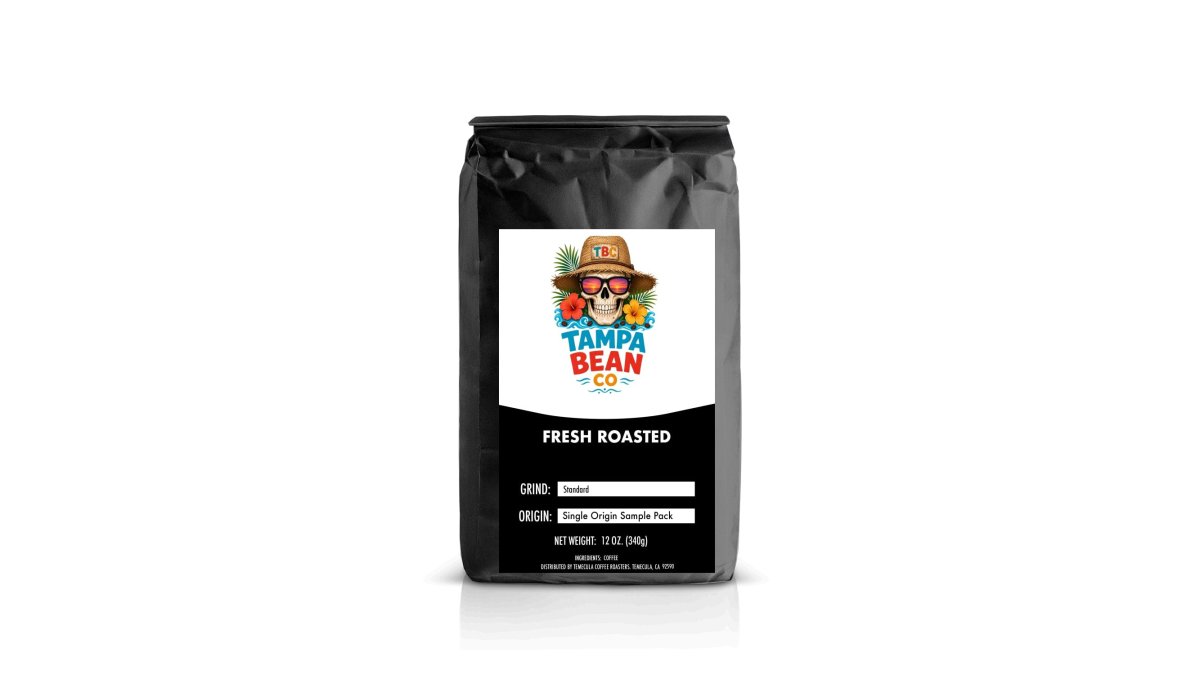
| Best Sellers Sample Pack | Mixed | Six 2oz packs across the range | First-time buyers |
| Single Origin Favorites Sample Pack | Mixed | Six 2oz single origins | Exploring origins |
Coffee Roast Profiles Explained: Light, Medium, and Dark
Coffee roast profiles explained simply: roast level describes how long and how hot the beans were roasted, and it determines how much acidity, body, and sweetness ends up in your cup. Lighter roasts keep more origin character. Darker roasts trade that for bold, roasty flavor.

What Each Roast Level Does to Flavor
- Light roast: Higher acidity, brighter fruit and floral notes, lighter body. Tampa Bean Company's Ethiopia Natural sits at medium-light with milk chocolate, fruity, and caramel notes.
- Medium roast: Balanced acidity and body, with sweetness and chocolate tones. The House Blend, Breakfast Blend, Brazil Santos, and Colombia all land here.
- Dark roast: Low acidity, heavy body, smoky and bittersweet. The Italian Roast is the darkest option in the range.
A common mistake is assuming darker means stronger caffeine. It doesn't; roast level changes flavor far more than caffeine content.

The Best Coffee for Pour Over and Other Brewing Methods
The best coffee for pour over is a medium or medium-light roast with clear sweetness and moderate acidity, ground medium-fine. Ethiopia Natural and Colombia both fit that brief, and Brazil Santos works if you prefer a smoother, cocoa-forward cup.

Matching Grind Size to Your Brewer
Grind size decides how fast water moves through the coffee, which controls extraction. Too coarse gives sour, weak coffee; too fine gives bitter, over-extracted coffee.
| Brewer | Grind Size | Why It Works |
|---|---|---|
| Pour over | Medium-fine | Even extraction through a paper filter |
| French press | Coarse | Metal mesh needs bigger particles |
| Drip machine | Medium | Matches standard basket filters |
| Espresso | Fine | High pressure needs a dense puck |
| Cold brew | Coarse | Long steep time, low bitterness |
Single Origin vs Blends: Which Bag Belongs in Your Cart
Single origin coffee comes from one region or farm, so it tastes like that place. Blends combine multiple origins for a consistent, balanced cup that doesn't shift with each harvest.
How to Store Coffee Beans for Maximum Freshness
Knowing how to store coffee beans for maximum freshness comes down to four enemies: oxygen, light, heat, and moisture. But the real question online buyers ask is simpler: how long do beans stay good after opening? The answer depends on the storage method.
The Shelf-Life Timeline After Opening
Roasted coffee releases carbon dioxide for the first few days after roasting, a process called degassing, which is why a bag roasted yesterday can brew flat or foamy. Once degassing slows, typically around day three to five, the coffee hits its flavor peak. Most roasters agree whole beans hold their best quality for roughly two to four weeks after the roast date, then decline gradually.
Storage Methods Ranked by How Well They Preserve Flavor
| Method | How Long Flavor Holds | Trade-off |
|---|---|---|
| Original bag, rolled and clipped | 1-2 weeks | Convenient, but the one-way valve only helps before opening |
| Airtight opaque canister, room temp | 2-4 weeks | Best everyday option; keep it out of sunlight and away from the stove |
| Airtight canister in the fridge | Not recommended | Coffee absorbs fridge odors and picks up moisture each time you open it |
| Vacuum-sealed freezer portions | 1-2 months | Works only if portions are truly airtight and thawed sealed before opening |
A common pattern among home brewers is to buy a two-week supply, transfer it to an opaque airtight canister, and store it in a cool cupboard. That habit solves most freshness problems without special equipment.
Why the Freezer Is Misunderstood
The freezer isn't the enemy; moisture and repeated temperature swings are. If you freeze coffee, portion it into bags you'll open once, squeeze out the air, seal them, and let each portion reach room temperature before grinding. Opening a frozen bag, scooping beans, and putting it back introduces condensation every time, which is what actually damages the coffee. For daily drinkers, room-temperature storage in a good canister is simpler and just as effective.
Whole Bean vs Pre-Ground and Reading the Roast Date
Whole bean is better for freshness; pre-ground is better for convenience. If you don't own a grinder, ordering custom-ground coffee matched to your brewer beats buying whole beans you can't use well. But that's only half the decision, the other half is reading the date on the bag, where most online coffee shopping goes wrong.
Whole Bean vs Pre-Ground: The Practical Trade-off
Whole beans stay fresh longer because less surface area is exposed to oxygen. Grinding exposes the bean's interior, and aroma compounds start escaping within hours. If you brew daily and own a burr grinder, whole bean is almost always the better buy.
How to Read a Roast Date (and Why 'Best By' Tells You Nothing)
Roast date transparency is the single most useful signal when you buy fresh roasted coffee online, and it's the one most shoppers ignore. Here's how to read what's on the bag:
- Roast date: The day the beans were roasted. This is the date you want. Coffee tastes best roughly two to four weeks after this date, with the first few days reserved for degassing.
- Best by date: Often set six to twelve months after roasting. It tells you when the coffee is technically safe, not when it tastes good.
- Expiration date: The least useful of the three. It says nothing about flavor quality.
- No date at all: A red flag. You have no way to know how old the coffee is.
Why 'Roasted-to-Order' Beats 'Best By'
Roasted-to-order roasters roast after you order, then ship within a day or two, so the bag arrives within days of the roast date rather than weeks or months. Grocery beans may sit in a warehouse, then on a shelf, then in your pantry, and by the time you brew them, the peak window has passed.
Pricing, Delivery, and What Your Daily Cup Actually Costs
A $22.99 bag of Tampa Bean Company coffee works out to roughly $1.30 per cup across about 17 brewed cups, depending on dose and method. Compare that to a daily coffee shop habit and the math gets uncomfortable fast.
- Bag price: $22.99 for a 12oz bag
- Cups per bag: roughly 17 to 18
- Cost per cup: about $1.30
- Sample packs: $26.99 for six 2oz packs
Frequently Asked Questions
How can you tell if coffee beans are actually fresh?
Check the roast date, not just the best-by date. Fresh roasted coffee tastes best within two to four weeks of roasting, so a bag stamped with a recent date is your best signal. Whole beans also tell on themselves: they smell sweet and release visible gas when you open the bag. If a bag has no roast date at all, you have no way to judge freshness, which is a reason to look elsewhere.
What is the best coffee for pour over?
Medium and medium-light roasts work best for pour over because they keep the brighter acidity and delicate tasting notes that filter brewing highlights. A medium roast single origin like Colombia, with its dried orange, berry, and chocolate notes, suits a slow pour over well. Grind matters just as much: ask for a medium grind, roughly the texture of table salt, so water flows evenly through the bed.
Should I buy whole bean or pre-ground coffee online?
Whole bean stays fresh longer because the oils and aromatics stay sealed inside the bean. Grinding exposes surface area to air, so ground coffee loses its edge within days rather than weeks. Buy whole bean if you own a grinder. If you do not, choose a roaster that grinds to order for your specific brewer, which beats a generic supermarket grind every time.
How long does fresh roasted coffee stay fresh after delivery?
Plan on peak flavor for about two to four weeks after the roast date. Right after roasting, beans release carbon dioxide in a process called degassing, which is why most roasters wait a day or two before shipping. Keep the bag sealed and away from light, heat, and moisture. Beyond a month, the coffee is still drinkable but the aroma and complexity fade noticeably.
How do I store coffee beans for maximum freshness?
Keep beans in an airtight, opaque container at room temperature, away from the stove, the window, and the fridge door. Oxygen, light, heat, and moisture are the four things that flatten flavor fastest. Do not move coffee to the freezer unless you are storing a full unopened bag for months, since repeated thawing pulls moisture into the beans. Buy in amounts you will finish within a few weeks.