

Coffee Brewing Methods for Beginners: 2026 Guide
Table of Contents
- Essential Coffee Brewing Tools for Beginners
- Coffee Grind Size Chart for Beginners
- Best Coffee to Water Ratio for Pour Over
- How to Choose Coffee Beans for Home Brewing
- Pour-Over, French Press, and AeroPress: Coffee Brewing Methods Compared
- Auto-Drip and Moka Pot: Convenient Coffee Brewing Methods for Beginners
- Common Mistakes to Avoid with Coffee Brewing Methods
- Frequently Asked Questions
Last Updated: September 24, 2026
Essential Coffee Brewing Tools for Beginners
You don't need a wall of equipment to make excellent coffee at home. Coffee brewing methods for beginners really come down to four tools: a scale, a decent grinder, a kettle, and one brewing device. Everything else is optional.
Here's the shortlist worth buying first:
- Digital scale (0.1g precision): coffee-to-water ratio is guesswork without one
- Burr grinder: blade grinders produce uneven particles that cause channeling
- Gooseneck kettle: gives you control over pour speed and agitation
- Brewing device: pour-over dripper, French press, or AeroPress
Coffee Grind Size Chart for Beginners
Grind size determines how fast water extracts flavor. Too coarse gives a weak, sour cup; too fine gives bitterness and clogged filters.
| Brewing Method | Grind Size | Texture Reference | Typical Brew Time |
|---|---|---|---|
| French press | Coarse | Sea salt | 4 minutes |
| Auto-drip | Medium | Table salt | 5-6 minutes |
| Pour-over | Medium-fine | Fine sand | 2.5-3 minutes |
| AeroPress | Fine to medium-fine | Between sand and powder | 1.5-2.5 minutes |
| Moka pot | Fine | Powdered sugar | 3-4 minutes |
Best Coffee to Water Ratio for Pour Over
The best coffee to water ratio for pour over is 1:16 by weight, meaning 1 gram of coffee for every 16 grams of water. For a standard mug, that's roughly 18g of coffee to 300g of water.
How to Choose Coffee Beans for Home Brewing
Learning how to choose coffee beans for home brewing starts with two decisions: roast level and freshness. Everything else, origin, processing method, flavor notes, is refinement.
Roast Level: Match the Bean to Your Brewer
Roast level shapes flavor more than any other single factor, and it interacts with your brewing method:
- Light roast: brighter acidity, more origin character, delicate floral and fruit notes. Best in pour-over, where paper filtration and controlled temperature preserve those fragile compounds. Struggles in a French press, where the metal filter and long steep can muddy the clarity.
- Medium roast: balanced sweetness and body, the safest starting point for any method. If you only buy one bag to test your new setup, buy a medium roast.
- Dark roast: deeper, heavier, chocolate-and-nut flavor, and more forgiving of technique. Works well in immersion brewing (French press, AeroPress) and moka pot, where the roast's own boldness covers small extraction errors.
Freshness: The Variable Beginners Underestimate
Coffee degasses after roasting, releasing carbon dioxide that interferes with even extraction. Beans rested a few days past roast perform better than beans roasted the same morning, and whole bean holds its flavor far longer than pre-ground. Here's the practical freshness window most roasters work within:
- Days 1-3 post-roast: too fresh for most brew methods; the bloom is violent and extraction is uneven
- Days 4-14: peak flavor window for filter and immersion brewing
- Days 15-30: still drinkable, but aromatics fade noticeably
- Beyond 30 days: flat, papery, or stale-tasting regardless of method
A Beginner's Bean-Buying Checklist
- Roast date printed? If not, walk away.
- Whole bean or pre-ground? Whole bean if you own a burr grinder; pre-ground only if you'll finish the bag within two weeks.
- Roast level matched to your brewer? Medium for auto-drip, medium-fine-friendly roasts for pour-over, medium-to-dark for French press and moka pot.
- Bag size matched to your pace? A 12 oz bag lasts roughly two weeks at one 18g cup per day. Buy smaller if you drink less.
Once roast level and freshness are dialed in, origin and processing method become the fun part.
Pour-Over, French Press, and AeroPress: Coffee Brewing Methods Compared
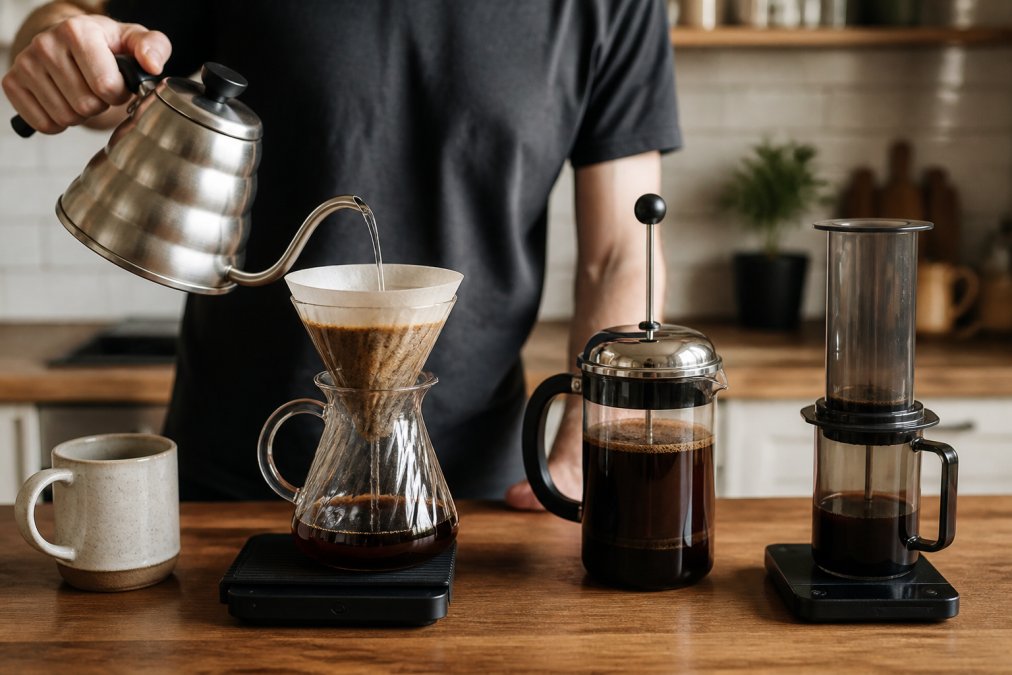
Three brewers dominate beginner recommendations, each producing a genuinely different cup. The real question isn't "which is best", it's "which one matches the coffee you want to drink and the morning you actually have."
Start With Flavor, Not Equipment
Before reading any step-by-step, ask which of these two cups sounds better:
- "I want a clean, bright cup where I can taste the fruit and floral notes of the bean." → You want pour-over or AeroPress.
- "I want a rich, heavy cup with body and depth, closer to what a café calls 'bold.'" → You want French press.
| Method | Body | Clarity | Acidity | Best For |
|---|---|---|---|---|
| Pour-over | Light | High | Pronounced | Flavor-focused drinkers who want to taste origin character |
| French press | Full | Low | Muted | Drinkers who want richness and don't mind sediment |
| AeroPress | Medium | High | Balanced | Drinkers who want flexibility and speed in one device |
Pour-Over: Clean and Bright
Pour-over uses percolation: water passes through a bed of coffee and a paper filter, which traps oils and fine particles for a clean cup with high clarity and pronounced acidity.
Steps:
- Rinse the paper filter with hot water to remove paper taste
- Add medium-fine coffee and level the bed
- Pour a small amount of water to saturate the grounds and let it bloom for 30 seconds
- Pour in slow circles, keeping the slurry temperature steady
- Finish when total brew time hits 2.5 to 3 minutes
French Press: Full-Bodied and Rich
French press is immersion brewing. Coffee steeps in full contact with water, then a metal mesh filter separates the grounds. Nothing traps the oils, so the cup is full-bodied and heavy.
Steps:
- Add coarse coffee to the carafe
- Pour hot water over the grounds and stir gently
- Let it steep for 4 minutes
- Press the plunger down slowly and evenly
- Pour immediately to stop extraction
AeroPress: Fast and Versatile
AeroPress combines immersion and pressure in a compact device: you steep briefly, then press through a filter by hand, giving you control over extraction yield.
Steps:
- Add a paper or metal filter to the cap
- Add fine-to-medium-fine coffee
- Pour water and stir for 10 seconds
- Steep for 1 to 2 minutes
- Press slowly over 20 to 30 seconds
Cost of Entry: What Each Method Actually Requires
Most guides skip what a complete setup costs. Here's the honest breakdown by tier, assuming you own nothing:
| Tier | What You Need | Typical Range |
|---|---|---|
| Minimum viable | Hand burr grinder + scale + French press or AeroPress | Entry-level |
| Comfortable | Electric burr grinder + scale + gooseneck kettle + pour-over dripper | Mid-range |
| Full setup | Electric burr grinder + scale + temperature-controlled kettle + two brewers | Higher |
The Decision, in One Paragraph
Want clarity and don't mind attention? Choose pour-over. Want body and forgiveness? French press. Want speed and range in one device? AeroPress. All three reward fresh beans and a consistent grind, none will fix stale coffee. Pick the one matching the cup you already like, and you'll stick with it long enough to get good.
| Method | Grind | Brew Time | Body | Clarity | Best For |
|---|---|---|---|---|---|
| Pour-over | Medium-fine | 2.5-3 min | Light | High | Flavor-focused drinkers |
| French press | Coarse | 4 min | Full | Low | Rich, heavy cups |
| AeroPress | Fine to medium-fine | 1.5-2.5 min | Medium | High | Speed and flexibility |
Auto-Drip and Moka Pot: Convenient Coffee Brewing Methods for Beginners
Auto-drip machines and moka pots trade control for convenience, and both earn a place in a beginner's kitchen.
Common Mistakes to Avoid with Coffee Brewing Methods
Most beginner frustration traces back to a handful of fixable errors:
- Using a blade grinder: uneven particles cause channeling, where water finds the path of least resistance and leaves part of the bed under-extracted
- Ignoring water temperature: water that's too hot scorches the grounds and adds bitterness; too cool and you under-extract
- Skipping the bloom: fresh coffee needs 30 seconds to release carbon dioxide, or it brews unevenly
- Eyeballing the ratio: a scoop of coffee can vary by several grams depending on grind and bean
- Stale beans: no technique rescues coffee that's been sitting in a cupboard for two months
Frequently Asked Questions
What are the four best coffee brewing methods for beginners?
The four most beginner-friendly coffee brewing methods are pour-over, French press, AeroPress, and auto-drip. Pour-over gives you a clean, bright cup with full control. French press is simple and produces a full-bodied coffee. AeroPress is fast and versatile. Auto-drip is the most hands-off option. All four require minimal skill and basic equipment, making them ideal starting points for anyone new to home brewing.
How does grind size affect different coffee brewing methods?
Grind size controls how fast water extracts flavor from your coffee. A coarse grind works best for French press because a metal mesh filter needs larger particles to avoid sludge. Medium-fine suits pour-over and auto-drip. Fine grinds work for AeroPress and Moka pot. If your coffee tastes bitter, grind coarser. If it tastes sour or weak, grind finer. A burr grinder gives you consistent particles, which matters more than any other tool.
Do I need expensive equipment to brew great coffee at home?
No. A basic setup with a burr grinder, a scale, and one brewing device like a pour-over cone or French press covers most of what you need. A gooseneck kettle helps with pour-over control but is not mandatory. Fresh beans and consistent grind size matter far more than pricey gear. Start with the essentials and add tools as your preferences develop.
What is the healthiest method of making coffee at home?
Paper filter methods like pour-over and auto-drip remove more of the oils and cafestol from coffee, which some research links to higher cholesterol levels. French press and Moka pot leave more oils in the cup. If you drink several cups a day and want to limit cafestol intake, a paper filter is a practical choice. All methods produce coffee that fits into a balanced routine.
What method makes the smoothest coffee?
Pour-over with a paper filter typically produces the smoothest cup because the filter traps oils and fine particles, leaving a clean, clear body. Cold brew also delivers a smooth result with low acidity, though it takes 12 to 18 hours. French press gives a heavier, more textured cup. If smoothness is your priority, start with pour-over and adjust your coffee-to-water ratio to taste.