

Best Coffee Beans for French Press: 7 Top Picks
Table of Contents
- Quick Comparison: Best Coffee Beans for French Press
- How We Evaluated These French Press Beans
- 1. House Blend: Best Overall for Everyday French Press
- 2. Breakfast Blend: Best Smooth and Easy-Drinking Pick
- 3. Latin American Blend: Best for Full-Bodied Immersion Brewing
- Coarse Grind vs Fine Grind for French Press
- 4. Brazil Santos: Best Single-Origin for Cocoa Notes
- 5. Colombia: Best Single-Origin for Bright, Fruity Cups
- 6. Guatemala: Best Single-Origin for Chocolate and Butterscotch Depth
- 7. Sumatra: Best for a Syrupy Body and Low Acidity
- How to Store Coffee Beans for Maximum Freshness
- A few habits make a real difference:
- The Role of Water Chemistry, Acidity, and Body
- Sustainability and Ethical Sourcing Metrics
- Frequently Asked Questions
Last Updated: September 27, 2026
Quick Comparison: Best Coffee Beans for French Press
The best coffee beans for French press are medium to medium-dark roasts with a coarse, consistent grind, because immersion brewing rewards body, sweetness, and low bitterness over delicate top notes. At Tampa Bean Company, we deliver quality, consistent coffee directly from the bay to your doorstep, so the beans reach your kitchen with oils and aroma intact. Below, we break down seven picks by flavor profile, then explain how grind size, roast level, and water chemistry change your cup.
Quick Picks:
- Best Overall: House Blend, a smooth medium roast that works with almost any French press routine
- Best Smooth and Easy-Drinking: Breakfast Blend, a gentle South American blend for daily cups
- Best Full-Bodied: Latin American Blend, a medium-dark roast built for immersion brewing
- Best Single-Origin for Cocoa: Brazil Santos, elegant and smooth with clear cocoa notes
- Best Single-Origin for Brightness: Colombia, with dried orange, berry, and chocolate
- Best Single-Origin for Depth: Guatemala, layering dark chocolate, bright fruit, and butterscotch
| Coffee | Roast Level | Tasting Notes | Best For |
|---|---|---|---|
| House Blend | Medium | Nutty, sweet chocolate, mild citrus | Everyday French press |
| Breakfast Blend | Medium | Smooth, mellow | Easy-drinking morning cups |
| Latin American Blend | Medium-dark | Nutty, mild fruit, cocoa finish | Full-bodied immersion brewing |
| Brazil Santos | Medium | Cocoa | Cocoa-forward single origin |
| Colombia | Medium | Dried orange, berry, chocolate | Bright, fruity cups |
| Guatemala | Medium | Dark chocolate, bright fruit, butterscotch | Layered depth |
| Sumatra | Medium | Dark chocolate, dried fruit, earthy | Syrupy body, low acidity |
How We Evaluated These French Press Beans
Every coffee here had to pass three tests: how it behaves under full immersion, how it tastes without milk or sugar, and how consistent the roast is bag to bag. French press brewing is unforgiving, a fine grind turns the cup muddy, a stale bean turns it flat, so freshness and grind compatibility carried as much weight as flavor.

1. House Blend: Best Overall for Everyday French Press
The House Blend is our top pick because it balances body and clarity better than anything else here. It is a medium roast of Central and South American coffees, with a medium body and notes of nutty, sweet chocolate, mild citrus, and a clean bright finish. That clean finish matters: immersion brewing traps fine particles and oils that can read as muddy, and too much acidity turns harsh when it steeps.
These blended coffees are both natural/dry processed and wet mill washed/sun dried. At $22.99 for a 12-ounce bag, it offers cost-effective pricing compared to brick-and-mortar coffee shops. Order it whole bean and grind coarse at home, or let us set the grind for a French press at checkout.
2. Breakfast Blend: Best Smooth and Easy-Drinking Pick
Breakfast Blend is the coffee to reach for when you want something gentle before you have fully woken up. It is a medium roast of South American coffees with a mellow, rounded profile that never turns sharp, a good match for drinkers who find brighter coffees too acidic in a French press, or who add a splash of milk. It also handles a longer steep without turning bitter.

The 12-ounce bag runs $22.99, the same as the rest of our core lineup.
3. Latin American Blend: Best for Full-Bodied Immersion Brewing
Full-bodied is the whole point of a French press, and the Latin American Blend delivers it more than any other coffee here. It is a medium-dark roast of select Latin American coffees, blended for full flavor with nutty hints, mild fruity tones, and a gentle cocoa aftertaste. The beans are shade grown in Central American rain forests and in volcanic soil near the Amazon, then washed and sun dried for up to seven days, which pulls out sweetness and keeps the body syrupy rather than thin.

Coarse Grind vs Fine Grind for French Press
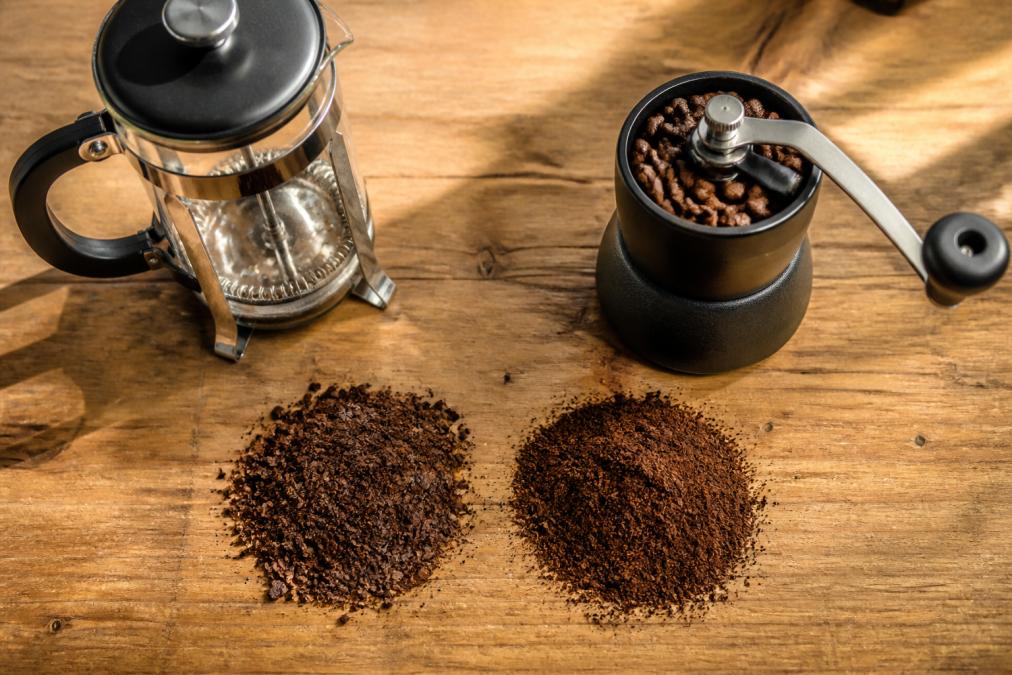
Coarse grind is the correct choice for French press because the metal mesh filter cannot trap fine particles the way a paper filter does. A grind roughly the size of sea salt lets water extract flavor while keeping most sediment out of your cup. Go finer and you get sludge; go much coarser and the cup tastes weak.
The difference shows up fast in the cup:
- Coarse grind: clean body, minimal sediment, even extraction over four minutes
- Medium grind: faster extraction, more sediment, risk of bitterness
- Fine grind: heavy sludge, clogged mesh, harsh and muddy flavor
4. Brazil Santos: Best Single-Origin for Cocoa Notes
Brazil Santos is the pick for drinkers who want one clear flavor note done well. It is a medium roast from Fazenda Santa Barbara in the Parana and Sao Paulo regions, grown between 750 and 1,050 meters in volcanic loam, with an elegant, smooth cup and cocoa notes. The Catuai and Mundo Novo varieties are pulped natural and sun dried, which leaves some fruit sugars on the bean and rounds out the acidity, in a French press, that shows up as a soft, chocolatey cup with almost no sharp edges.
5. Colombia: Best Single-Origin for Bright, Fruity Cups
Colombia is the brightest coffee on this list, and that is exactly why it earns a spot. It is a medium roast from smallholder farmers around Medellin, grown at 1,300 to 1,500 meters, with a tasting profile of dried orange, berry, and chocolate. The Castillo, Caturra, Colombia, and Typica varieties are fully washed and dried in solar dryers to protect the beans from rain, which keeps the cup clean and the fruit notes distinct, in a French press, you get a lively cup with a chocolate base and a citrus lift on the finish. The 12-ounce bag is $22.99.
6. Guatemala: Best Single-Origin for Chocolate and Butterscotch Depth
Guatemala is the most layered coffee here, and it rewards a slower morning. It is a medium roast from smallholder farmers in Antigua, grown between 1,200 and 1,616 meters in volcanic loam, with a tasting profile of dark chocolate, bright fruit, and butterscotch. The Bourbon, Catuai, Caturra, and Typica varieties are fully washed and sun dried, which keeps the cup clean while preserving the sweetness, in a French press, the butterscotch note sits on top of a dark chocolate base, with the fruit cutting through at the end.
7. Sumatra: Best for a Syrupy Body and Low Acidity
Sumatra is the outlier on this list, and the one to choose if you like your coffee heavy and earthy. It is a medium roast from the Aceh region, grown between 1,100 and 1,600 meters by the Koperasi Baitul Qiradh Baburrayyan cooperative, with cupping notes of medium acidity, syrupy body, dark chocolate, dried fruit, and a long lingering finish.
The 12-ounce bag is $22.99.
How to Store Coffee Beans for Maximum Freshness
Store whole beans in an airtight, opaque container at room temperature, away from light, heat, and moisture, and grind them right before brewing. Whole bean coffee keeps its oils and aroma far longer than pre-ground, because the bean's protective structure stays intact until you break it.
A few habits make a real difference:
- Grind coarse just before you brew, not the night before
The Role of Water Chemistry, Acidity, and Body
A simple starting point: one rounded tablespoon of coarse grounds per 4 ounces of water, a four-minute steep, and a slow press. Adjust from there.
Sustainability and Ethical Sourcing Metrics
The House Blend uses natural and wet-mill washed processing, methods friendly to the environment, the rain forests and the living creatures of the high elevation mountains where these coffees are grown; the Latin American Blend is shade grown in the Central American rain forests and in volcanic soil near the Amazon rain forest, and full sun dried for up to 7 days; and Brazil Santos, Colombia, and Guatemala each name the grower, region, altitude, and soil type.
Frequently Asked Questions
Is coarse or fine ground coffee better for a French press?
Coarse ground coffee is better for a French press. The metal mesh filter has wider holes than a paper filter, so fine grounds slip through and end up in your cup as sludge. A coarse grind, similar to sea salt, lets the mesh catch the grounds while water still extracts flavor during the four-minute steep. If your grind is too fine, you will notice grit at the bottom of every cup and a bitter, over-extracted taste.
What is the best French press coffee ratio?
A heaping tablespoon per 4 ounces of water works if you do not have a scale.
Can I use pre-ground coffee in a French press?
You can, but the results depend on the grind size. If pre-ground is your only option, look for a coarse grind option at checkout or use a slightly shorter steep time.
Does the origin of the coffee bean affect French press flavor?
Yes, and the effect is noticeable because immersion brewing pulls out more of the bean's oils and body. A Brazil Santos brings cocoa and smoothness, a Colombia adds dried orange and berry brightness, and a Sumatra delivers earthy, syrupy depth. The metal mesh filter lets those oils through, so origin differences show up more clearly in a French press than in a paper-filtered brew.
How does fresh roasted coffee beans delivery help French press brewing?
Fresh roasted coffee beans delivery matters because French press brewing depends on oils for body and mouthfeel. Ordering whole bean coffee that ships soon after roasting, then grinding right before you brew, keeps the flavor compounds intact.