

How to Choose Coffee Grind Size: 2026 Guide
Table of Contents
- Why Coffee Grind Size Decides How Your Cup Tastes
- Coffee Grind Size Chart: Coarse to Fine at a Glance
- How to Match Grind Size to Your Brew Method
- How to Dial In Espresso Grind Without Wasting Beans
- Best Coffee Beans for French Press (and How Roast Level Changes Grind)
- Grinder Calibration, Maintenance, and Visual Checks
- Common Grind Size Mistakes to Avoid
- Conclusion: Grind With Intent, Brew With Confidence
- Frequently Asked Questions
Last Updated: September 25, 2026
Why Coffee Grind Size Decides How Your Cup Tastes
Learning how to choose coffee grind size is the single highest-use adjustment in home brewing. Get it right and a modest bean tastes vivid; get it wrong and a superb one tastes flat or harsh.
Surface Area, Particle Size, and Extraction
Water dissolves flavor compounds from the outside of each particle inward. Halve the particle size and you roughly quadruple the surface area, accelerating extraction. Grind too coarse and water never reaches the interior before the brew ends; grind too fine and it pulls bitter, astringent compounds out long before the brew finishes.
What Under-Extracted and Over-Extracted Coffee Taste Like
Under-extracted coffee tastes sour, sharp, and thin, hitting the front of your tongue with a bright, almost salty edge. The usual cause is a grind too coarse for the brew time.
Coffee Grind Size Chart: Coarse to Fine at a Glance
A coffee grind size chart maps each brew method to a micron range. Use it as a starting point, then adjust by taste, because bean density, roast level, and grinder calibration all shift the target.
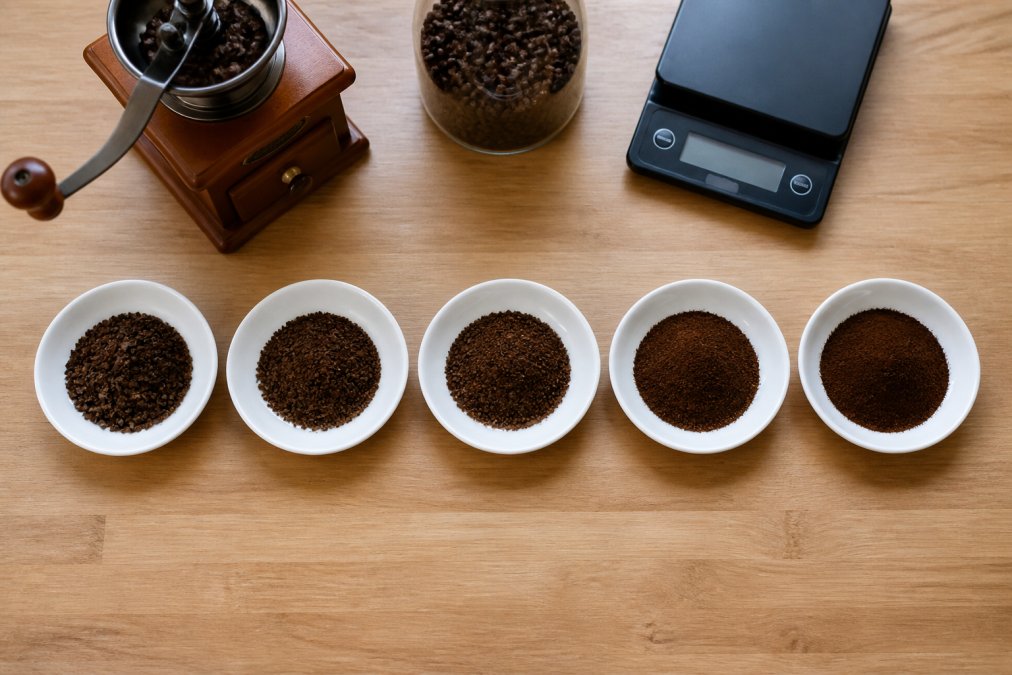
| Grind | Approximate Microns | Texture Reference | Best Brew Method |
|---|---|---|---|
| Extra coarse | 1,200+ | Peppercorns | Cold brew, percolator |
| Coarse | 900-1,200 | Sea salt | French press |
| Medium-coarse | 700-900 | Rough sand | Chemex, clever dripper |
| Medium | 500-700 | Table salt | Drip, flat-bed pour-over |
| Medium-fine | 400-500 | Fine sand | Cone pour-over, AeroPress |
| Fine | 200-400 | Powdered sugar | Espresso, moka pot |
| Extra fine | Under 200 | Flour | Turkish, Ibrik |
How to Read the Chart in Microns
Microns measure particle diameter in thousandths of a millimeter. A French press wants particles between 900 and 1,200 microns; espresso wants them under 400, which is why one grinder setting rarely works across both.
How to Match Grind Size to Your Brew Method
Matching grind to method comes down to one rule: the longer the water contacts the coffee, the coarser the grind should be. A four-minute French press steep needs coarse particles; a 25-second espresso shot needs fine ones. But the rule is a starting point, most guides ignore roast density and non-standard brewers that don't fit the chart.
The Standard Methods, With the Numbers That Matter
- French press: coarse, 900-1,200 microns, steeped around four minutes. The metal mesh filter lets fine particles through, so a uniform coarse grind keeps sediment out.
- Pour-over: medium to medium-fine, roughly 400-700 microns, two to four minutes total. Cone drippers run finer than flat-bed drippers because the bed is deeper and flow is slower.
- Drip machine: medium, around 500-700 microns, because the automatic cycle fixes contact time for you.
- Cold brew: extra-coarse, above 1,200 microns, because a 12- to 18-hour steep will over-extract anything finer.
Non-Standard Brewers Most Guides Skip
These methods sit between the chart's rows, and getting them right is where home brewers quietly lose cups:
- AeroPress: forgiving across medium-fine to fine (roughly 300-500 microns). It's the best method for experimenting with grind adjustment, since you can shorten or lengthen the steep to compensate.
- Moka pot: close to espresso but slightly coarser, 300-500 microns, since stovetop pressure is lower than a pump machine. Too fine and the pot sputters and scorches; too coarse and the brew tastes weak.
- Siphon / vacuum pot: medium-fine, around 400-600 microns, 90 seconds to 2 minutes total. The filter and vacuum draw reward a slightly coarser grind than pour-over.
- Turkish / Ibrik: extra-fine, under 200 microns, ground to a flour-like powder that stays suspended in the cup.
Roast Level Changes the Target
Roast level changes grind requirements more than most brewers realize. Darker roasts are more porous and less dense, so they extract faster and often need a slightly coarser setting than a light roast at the same brew time. A light-roast Ethiopian and a dark-roast Sumatra at the same French press setting will not taste the same. As a rule of thumb, nudge one to two clicks coarser for a dark roast and one to two clicks finer for a light roast, then adjust by taste.
Match the Method to the Bean, Not Just the Chart
For French press, medium and medium-dark roasts with chocolate, nut, or dried-fruit notes hold up well against the full-immersion body. Light roasts can work, but their higher density and brighter acidity demand a slightly finer grind and closer attention to steep time. This is where a roaster's grind option matters: Tampa Bean Company ships both whole bean and custom grinds matched to your brew method.
James Hoffmann's French press technique
Coffee roast level and density research
How to Dial In Espresso Grind Without Wasting Beans
Dialing in espresso means adjusting grind until a fixed dose yields a fixed weight of liquid in a fixed time. A common target is a 1:2 brew ratio: 18 grams in, roughly 36 grams out, in 25 to 30 seconds. What most guides skip is that the target shifts with the bean, and your grinder's calibration, not the dial number, determines whether you hit it.
Why the Same Setting Stops Working
Three variables move your espresso target between bags, and none of them are the grind number:
- Roast level. Darker roasts are more porous and less dense, so they extract faster and usually need a coarser setting than a light roast at the same dose and time, a light-roast Ethiopian and a dark-roast Sumatra can sit 3-5 clicks apart.
- Bean age. Freshly roasted coffee degasses for the first 7-14 days. CO2 pushes back against the pump, so a shot that ran 26 seconds on day 3 may run 22 seconds by day 10. Grind slightly finer as the bag ages.
- Humidity and dose drift. A 0.2-gram dose change is enough to shift shot time by 2-3 seconds. Weigh every dose; don't eyeball the basket.
A Repeatable Dial-In Sequence
- Lock your dose. Weigh the same amount of coffee for every shot, typically 18 grams.
- Lock your yield. Aim for double the dose in the cup, weighed on a scale.
- Time the shot. Start the clock when the pump engages.
- Adjust one variable. If the shot runs under 25 seconds, grind finer. If it runs past 30 seconds, grind coarser.
- Move in small steps. Change one notch at a time, then re-test. On a stepless grinder, move in 5-micron increments.
- Taste and confirm. Sour means go finer; bitter means go coarser.
Calibrate Before You Dial
A grinder that hasn't been calibrated will send you chasing a moving target. Find your grinder's true zero, where the burrs just touch, and note how many clicks each espresso setting sits from that reference. Recheck monthly, or any time the grinder has been disassembled for cleaning. Two grinders set to "fine" can land 100 microns apart, the whole game in espresso.
Reading the Shot, Not Just the Clock
Time and yield are the guardrails; taste is the verdict. A shot that hits 1:2 in 28 seconds can still taste thin if grind distribution is uneven, fines and boulders from a blade grinder or worn burrs channel water through the puck and leave most of the coffee under-extracted. If shots taste simultaneously sour and bitter, the problem is grind consistency, not grind size.
Best Coffee Beans for French Press (and How Roast Level Changes Grind)
Roast level changes grind requirements more than most brewers realize. Darker roasts are more porous and less dense, so they extract faster and often need a slightly coarser setting than a light roast at the same brew time.
Coffee roast level and density research
Grinder Calibration, Maintenance, and Visual Checks
Grinder calibration is the step almost everyone skips, and it's why two brewers with identical gear get different cups. Burr grinders hold a setting far better than blade grinders, which chop unevenly and produce fines and boulders no brew method can fix.
Common Grind Size Mistakes to Avoid
The biggest grind mistake is adjusting too many variables at once. Change grind, dose, water temperature, and brew time together and you learn nothing.
Other frequent errors:
- Buying pre-ground for espresso. Espresso needs grind adjustment as beans age, and pre-ground coffee can't be dialed in.
- Using a blade grinder for pour-over. The fines clog the filter and stall the brew, producing a bitter, uneven cup.
- Ignoring retention. Old grounds stuck in the chute contaminate the first dose after a grind change.
- Chasing a chart number over taste. Your palate, not the micron figure, is the final judge.
Conclusion: Grind With Intent, Brew With Confidence
Getting grind size right is the difference between a cup you tolerate and one you look forward to. Start with the chart, adjust one variable at a time, and let taste settle the argument.
Frequently Asked Questions
What is the perfect coffee grind size?
There is no single perfect coffee grind size. The right grind depends on your brew method, contact time, and taste. French press needs coarse grounds around 800 to 1000 microns, pour-over sits at medium to medium-fine, and espresso requires fine grounds near 200 to 300 microns. Start with the chart for your method, then adjust one notch finer or coarser based on whether your cup tastes sour or bitter.
How do I know if my coffee grind size is too fine or too coarse?
Taste is your fastest signal. Under-extracted coffee from too-coarse grounds tastes sour, thin, and salty. Over-extracted coffee from too-fine grounds tastes bitter, dry, and hollow. Check the spent grounds too: muddy sludge in a French press means you ground too fine, while watery, fast-draining pour-over beds point to too-coarse grounds. Adjust in small steps and keep your dose and brew ratio steady.
Does the roast level affect the grind size I should choose?
Yes. Darker roasts are more porous and dissolve faster, so they usually need a slightly coarser grind than light roasts for the same brew method. Light roasts are denser and more resistant to extraction, so grinding a step finer helps pull out sweetness and acidity. If you switch roasts and your cup suddenly tastes flat or sharp, adjust grind size before changing anything else.
What is the difference between burr and blade grinders for grind consistency?
Burr grinders crush beans between two sharp surfaces and produce uniform particle sizes, which means even extraction and repeatable results. Blade grinders chop beans with spinning metal, leaving a mix of fine dust and coarse boulders that brews unevenly. For anyone learning how to choose coffee grind size, a burr grinder is the single upgrade that makes every other adjustment predictable.