

How to Store Whole Bean Coffee for Peak Freshness
Table of Contents
- Why Whole Bean Coffee Loses Freshness
- How Long Does Coffee Stay Fresh?
- The Best Coffee Storage Containers
- Can You Freeze Coffee Beans?
- Step-by-Step: How to Store Whole Bean Coffee Properly
- Common Mistakes That Ruin Coffee Freshness
- Conclusion
- Frequently Asked Questions
Last Updated: September 28, 2026
Why Whole Bean Coffee Loses Freshness
Whole bean coffee starts losing freshness the moment it leaves the roaster. The main culprit is oxygen. When air hits the beans, it triggers oxidation, which strips away the oils and compounds that give coffee its flavor.
Roasted beans also release carbon dioxide in a process called degassing. That sounds harmless, but it pushes aroma out of the bean over time. Light, heat, and moisture speed up the damage.
This guide from Tampa Bean Company covers how to store whole bean coffee so every cup tastes like it was roasted yesterday. Below, we break down the science, the best containers, and a simple step-by-step routine.

How Long Does Coffee Stay Fresh?
Whole bean coffee stays fresh for about two to four weeks in a sealed bag at room temperature. After that, flavor fades fast.
Whole beans hold up much better than pre-ground coffee. Grinding exposes far more surface area to air, so ground coffee can go stale in days.
Here's a quick guide to shelf life:
| Storage Method | Typical Freshness |
|---|---|
| Sealed bag, pantry | 2-4 weeks |
| Airtight container, pantry | 4-6 weeks |
| Airtight container, freezer | 2-3 months |
| Pre-ground coffee, pantry | 3-7 days |
Check the roast date, not the best-by date. A bag roasted last week beats one roasted two months ago every time.
The Best Coffee Storage Containers
The best coffee storage container is the one that blocks all four enemies, oxygen, light, heat, and moisture, without trapping the carbon dioxide your beans are still releasing. That last part is what separates a real coffee canister from a generic airtight jar.
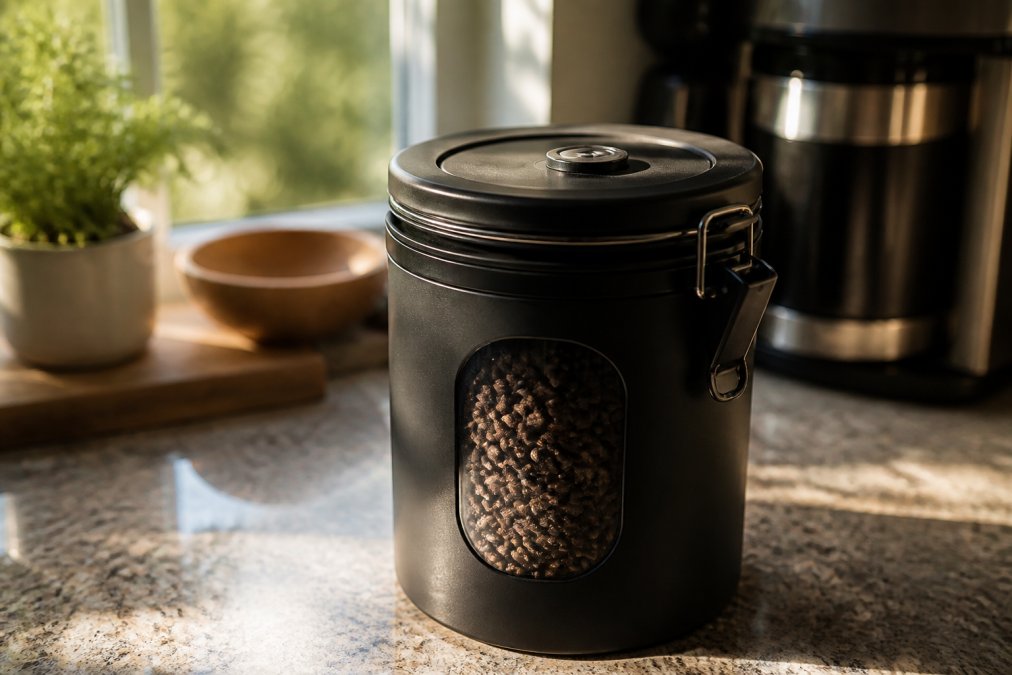
What to look for:
- Airtight seal: Keeps oxygen out and aroma in. A gasket or silicone ring is a good sign; a loose lid is not.
- Opaque body: Blocks light that breaks down oils. Stainless steel and matte ceramic are the usual picks. Clear glass looks great on a shelf and fails at its one job.
- One-way valve: Releases carbon dioxide without letting oxygen back in. This is the feature that lets you store freshly roasted beans without them going flat or building pressure.
- Right size: Buy a container that holds about a week of beans. A giant canister means more headspace, more oxygen, and more chances for beans to sit around getting old.
Why the one-way valve matters more than people think:
Freshly roasted beans release carbon dioxide for days after roasting. In a fully sealed jar, that gas builds up and can push the lid off, or, worse, force you to burp the container daily, which lets oxygen in each time. A one-way valve solves both problems: CO2 escapes, oxygen stays out. If you're buying beans within a week or two of the roast date, a valved canister is the difference between beans that stay bright and beans that taste flat by day ten.
Container types, ranked by what they actually do:
- Valved, opaque canisters: The everyday workhorse. Best balance of protection, convenience, and price for beans you'll finish in a week or two.
- Vacuum-sealed bags or vacuum canisters: The strongest oxygen barrier available at home. Best for beans you plan to store for more than a month, or for splitting a large order into portions. The trade-off is that vacuum sealing is slower to access and the bags are single-use unless you buy reusable ones.
- Nitrogen-flushed original bags: Many roasters ship beans in bags that have been flushed with nitrogen to displace oxygen. If your bag has a one-way valve and a resealable top, it's a legitimate short-term storage option, just don't leave it loosely rolled in the pantry for weeks.
- Clear glass jars, open bins, and decorative tins: Skip these. They fail on light, on air, or both. A pretty jar that stales your beans in ten days is not a storage solution.
Match the container to your roast and your climate:
Dark roasts carry more surface oil and degas faster, so they benefit most from a valved container that can vent CO2 without letting oxygen in. Light roasts are denser and degas more slowly, which means they're slightly more forgiving, but they still need an airtight, opaque home.
Climate changes the priority list too. In humid regions like Florida, moisture is the dominant threat, so the seal quality on your container matters more than almost anything else. In arid climates, oxygen and light do most of the damage, and a valved, opaque canister covers both. If you live somewhere with big seasonal humidity swings, consider vacuum sealing for long-term storage and using a valved canister for the week's worth you're actively drinking.
Can You Freeze Coffee Beans?
Yes, and for most home drinkers, the freezer is the single best tool for extending freshness past the two-to-four-week pantry window. The mechanism is simple: cold temperatures slow the oxidation reactions that strip oils and aromatics, and they also slow the release of carbon dioxide from the bean. Done right, whole beans hold peak flavor for two to three months in the freezer, and remain drinkable well beyond that.
The catch is moisture. Every time you pull a cold container out of the freezer and open it, warm room air rushes in and condenses on the beans. That surface moisture doesn't just dull flavor, it accelerates staling and can leave beans tasting flat and papery within days of thawing.
Freezing rules that actually matter:
- Portion before you freeze. Split beans into week-sized batches, roughly the amount you'll grind through in seven days. Once a portion is thawed, it should not go back in the freezer. Refreezing cycles beans through condensation repeatedly and wrecks them.
- Use a true barrier. Vacuum-sealed bags are the gold standard because they remove the oxygen that drives oxidation. Airtight, opaque containers with a one-way valve are the next best option, the valve lets residual CO2 escape without letting freezer air in. Standard zip-top bags are not a barrier; they're a suggestion.
- Squeeze out headspace. If you're using a rigid container, fill it as close to the top as practical. Less air inside means less moisture available to condense.
- Thaw sealed, then grind. Let the portion come to room temperature still sealed. Opening a cold bag is what causes condensation. Once it's at room temp, grind immediately and brew.
- Keep the freezer clean-smelling. Beans are porous and will pick up odors from nearby food. A dedicated shelf or drawer helps.
Freezer vs. fridge, the honest comparison:
A note on roast level:
Step-by-Step: How to Store Whole Bean Coffee Properly
Follow these steps to keep your beans at peak flavor:
- Buy whole bean coffee with a clear roast date on the bag.
- Transfer beans to an airtight, opaque container within a day of opening.
- Store the container in a cool, dark cupboard, away from the stove and oven.
- Keep beans away from direct sunlight and heat sources.
- Grind beans right before brewing for the best cup quality.
- Freeze extra beans in week-sized portions if you won't use them within a month.
- Clean your container every few weeks to prevent old oils from building up.
Common Mistakes That Ruin Coffee Freshness
A few habits quietly wreck fresh coffee. Here are the biggest ones:
- Storing beans in the fridge. The fridge is humid and full of food odors. Beans absorb both.
- Using a clear or open container. Light and air speed up oxidation.
- Grinding a week's worth at once. Ground coffee stales in days.
- Buying more than you'll drink. A month's supply sounds smart until week three.
- Ignoring the roast date. Best-by dates tell you nothing about freshness.
Conclusion
Storing whole bean coffee well comes down to four things: block oxygen, block light, block heat, and block moisture. Get those right and your beans stay fresh for weeks, not days.
Frequently Asked Questions
How long does a bag of whole bean coffee stay fresh?
Whole bean coffee stays at its peak for about 2 to 4 weeks after the roast date if kept in an airtight, opaque container away from heat and light. After that, it gradually loses aroma and flavor but remains safe to drink for several months. For the best cup, buy only what you will use within a month and store it properly.
Does whole bean coffee need to be refrigerated?
No, refrigeration is not necessary for daily use. The fridge exposes beans to moisture and odors from other foods, which can harm flavor. Instead, keep beans in an airtight container in a cool, dark cupboard. If you buy in bulk, freezing is a better option than refrigerating for long-term storage.
Is it okay to store coffee beans in a Ziploc bag?
Ziploc bags are not ideal because they are not airtight and let in oxygen, light, and moisture. While a bag might work for a day or two, for lasting freshness use an opaque, airtight container with a one-way valve. If you must use a bag, squeeze out excess air and keep it in a dark cupboard.
What is the best container for storing coffee beans?
The best container is opaque, airtight, and has a one-way valve to release carbon dioxide without letting oxygen in. Ceramic or stainless steel canisters with a silicone seal work well. Avoid clear glass or plastic containers that let light through, and never store beans in the original bag unless it is resealable and opaque.