

Best Grind Size for Pour Over: A 2026 Guide
Table of Contents
- Why Grind Size Makes or Breaks Your Pour Over
- How to Dial In Pour Over Coffee: A Step-by-Step Method
- Burr Grinder Settings for Pour Over: What to Change and When
- Troubleshooting Bitter or Sour Pour Over Coffee
- Brewer-by-Brewer Grind Size Chart: V60, Chemex, and More
- The Angles Most Guides Skip: Burr Geometry, Water Temp, and Calibration
- Matching Your Grind to the Bean: Picking the Right Coffee
- Frequently Asked Questions
Last Updated: September 30, 2026
Why Grind Size Makes or Breaks Your Pour Over
The grind size for pour over is the single most influential variable in brewing, and getting it wrong ruins an excellent bag of coffee. At Tampa Bean Company, we see the same pattern: brewers upgrade beans, kettle, and dripper, then keep the grind they used six months ago. The cup tastes flat, harsh, or thin, and the coffee gets blamed.
The Three Grind Categories: Fine, Medium, Coarse
Fine grind resembles powdered sugar and suits espresso, where water is forced through under pressure in under 30 seconds. Medium grind looks like table salt or coarse sand, this is where pour over lives. Coarse grind matches sea salt or raw sugar and suits French press and cold brew.
How to Dial In Pour Over Coffee: A Step-by-Step Method
Dialing in pour over coffee means adjusting your grind until the brew finishes in the right window and tastes balanced. Target a 2:30 to 3:30 draw-down for a single cup, though this shifts with dose size and dripper shape.
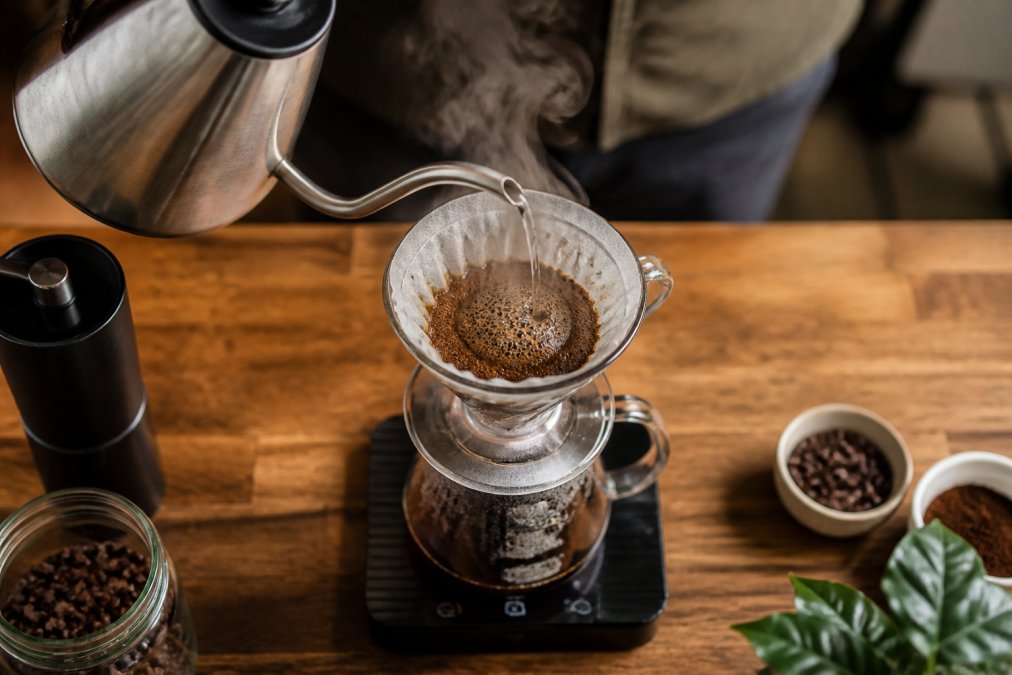
Follow this sequence:
- Start with a baseline recipe. Use a 1:16 brew ratio: 20 grams of coffee to 320 grams of water.
- Grind at medium and note the total brew time with a timer.
- Taste the result and identify whether it leans bitter or sour.
- Adjust the grind by one small step in the direction the taste tells you.
- Repeat with a fresh dose. Never re-brew the same grounds.
- Log each change so you can trace what worked.
Start With a Baseline Recipe
A fixed baseline removes guesswork. Write down dose, water weight, temperature, and total brew time before changing anything, without a reference point, you cannot tell whether an improvement came from the grind or something else. Use 20 grams of coffee and 320 grams of water at roughly 93°C. Bloom with 60 grams, wait 30 to 45 seconds, then pour in two or three stages.
Burr Grinder Settings for Pour Over: What to Change and When
Burr grinder settings for pour over are a starting point, not a fixed answer. Blade grinders produce inconsistent particles and make dialing in nearly impossible, so a burr grinder is the practical minimum.
| Symptom | Likely Cause | Grind Adjustment | What to Watch |
|---|---|---|---|
| Brew drains under 2 minutes | Grind too coarse | Go finer, 1-2 steps | Draw-down time increases |
| Brew stalls past 4 minutes | Grind too fine | Go coarser, 1-2 steps | Flow rate improves |
| Tastes sharp and sour | Under-extraction | Go finer | Sweetness develops |
| Tastes harsh and bitter | Over-extraction | Go coarser | Bitterness fades |
| Inconsistent cup to cup | Uneven particles | Check burr alignment | Particle uniformity |
Troubleshooting Bitter or Sour Pour Over Coffee
Troubleshooting bitter or sour pour over coffee comes down to one question: did the water extract too much or too little? Bitterness means over-extraction; sourness and sharp acidity mean under-extraction. Both are grind problems first and temperature problems second.
What Extraction Actually Does
Coffee contains hundreds of soluble compounds that dissolve at different rates: acids and fruity notes first, sugars next, bitter and woody compounds last. A well-extracted cup captures the first two groups and stops before the third. Under-extraction tastes sour, thin, and salty; over-extraction tastes bitter, dry, and hollow. Grind size controls that rate: finer particles expose more surface area and dissolve more compounds per second, while coarser particles slow extraction.
Bitter Coffee: Too Fine, Too Hot, Too Long
Bitterness shows up when the grind is too fine, the water too hot, or the brew too long. Fine particles release harsh compounds quickly, and water above roughly 96°C accelerates that. If the cup tastes dry and lingering, coarsen the grind one step before lowering temperature.
A diagnostic sequence:
- Check draw-down time. If the brew runs past 4:00, the grind is likely too fine. Coarsen one to two steps.
- Check water temperature. If draw-down is normal but the cup is still bitter, drop temperature by 2°C.
- Check the bed. A muddy, sludge-like bed after brewing signals excess fines. Coarsen the grind.
- Check the roast. Dark roasts are more soluble and bitter faster. Use cooler water and a coarser grind.
Sour Coffee: Too Coarse, Too Cool, Too Fast
Sourness means the water left before it pulled the sweetness out, caused by a coarse grind, water below 90°C, or a brew finishing under two minutes. Tighten the grind first; if still sour after two adjustments, raise water temperature in small increments.
A diagnostic sequence:
- Check draw-down time. If the brew finishes under 2:00, the grind is likely too coarse. Go finer one to two steps.
- Check water temperature. If draw-down is normal but the cup is still sour, raise temperature by 2°C.
- Check the bean. Light roasts are denser and less soluble. They often need a finer grind and hotter water than medium roasts.
- Check freshness. Coffee more than four weeks off roast can taste flat and sour regardless of grind.
The Visual Reference: What Each Grind Looks Like
A visual anchor beats words for grind size.
- Fine (espresso): Powdered sugar. Clumps when pinched, leaves a dusty residue on your fingers.
- Medium-fine (V60, Origami): Table salt. Individual particles visible, slight clumping when pinched.
- Medium (Kalita Wave, Melitta): Coarse sand. Particles separate easily, no clumping.
- Medium-coarse (Chemex): Sea salt. Distinct grains, feels gritty between fingers.
- Coarse (French press, cold brew): Raw sugar. Large, irregular particles, no fines visible.
The Adjustment Order That Works
When a cup tastes wrong, resist changing everything. Follow this order:
- Grind first. It has the largest effect and is the easiest to reverse.
- Temperature second. Adjust by 2°C at a time.
- Ratio third. Only after grind and temperature are dialed in.
- Technique last. Pour height, agitation, and pulse timing are fine-tuning, not fixes.
Brewer-by-Brewer Grind Size Chart: V60, Chemex, and More
Each brewer has a different filter and flow characteristic, so the ideal grind shifts within the pour over family. A V60's cone shape and paper filter reward a slightly finer grind than a Chemex, whose thicker filter slows flow on its own.
| Brewer | Grind Target | Typical Draw-Down | Notes |
|---|---|---|---|
| V60 | Medium-fine | 2:30-3:00 | Fast flow, sensitive to grind |
| Chemex | Medium-coarse | 4:00-5:00 | Thick filter slows drainage |
| Kalita Wave | Medium | 3:00-3:30 | Flat bed, forgiving |
| Origami | Medium-fine | 2:30-3:00 | Similar to V60 |
| Melitta | Medium | 3:00-3:30 | Widely available filters |
The Angles Most Guides Skip: Burr Geometry, Water Temp, and Calibration
Most guides stop at "medium grind, adjust to taste." That is correct but incomplete, because three variables change what "medium" means on your equipment: burr geometry, water temperature, and grinder calibration.
Burr Geometry: Why Two "Medium" Settings Taste Different
Burr geometry determines how coffee fractures, the most under-discussed variable in pour over brewing.
Water Temperature: The Hidden Grind Multiplier
Water temperature and grind size both control extraction rate, and they interact: hotter water extracts faster, so a slightly coarser grind at 95°C can taste like a finer grind at 90°C. Most home brewers change temperature without realizing they have effectively changed their grind.
A useful framework:
- Light roasts (90-96°C): Dense, less soluble. Use the hotter end and a slightly finer grind to pull sweetness out.
- Medium roasts (90-93°C): The standard window. Grind at medium and adjust from there.
- Dark roasts (85-90°C): More soluble and more brittle. Use cooler water and a slightly coarser grind to avoid bitterness.
Grinder Calibration: The Step Almost Nobody Teaches
Grinder settings drift. Burrs wear, burr carriers shift, and the "zero point", where burrs just touch, moves over months. Without recalibration, your reference points become meaningless and yesterday's perfect setting tastes different today.
A standardized calibration method:
- Empty the grinder completely. Run it briefly to clear retained grounds.
- Set the grind as fine as it will go while the grinder is running, listening for the moment the burrs begin to chirp or touch.
- Back off one or two steps from that contact point. This is your new zero reference.
- Count clicks from zero for every subsequent setting. Write the count down, not the dial number.
- Recheck every two to three months, or whenever a familiar setting starts behaving differently.
Fines: The Particles Every Grinder Produces
Every grinder produces fines, particles far smaller than the target size. A small amount is useful: fines migrate to the bed's bottom, slow flow, and add body. Too many choke the brew and push it bitter. A sludge-like bed or a brew stalling in the final third signals excess fines; coarsening one step often fixes it.
Matching Your Grind to the Bean: Picking the Right Coffee
Bean density, roast level, and processing method all influence how a coffee grinds and extracts. A naturally processed Ethiopian bean, like the Ethiopia Natural with its milk chocolate, fruity, and caramel notes, grinds differently than a washed bean from the same region. Lighter roasts are denser and often need a finer setting than darker roasts.

| Coffee | Roast | Tasting Notes | Pour Over Fit |
|---|---|---|---|
| Colombia | Medium | Dried orange, berry, chocolate | Balanced, versatile |
| Guatemala | Medium | Dark chocolate, bright fruit, butterscotch | Medium-fine grind |
| Brazil Santos | Medium | Cocoa, smooth | Forgiving, consistent |
| Ethiopia Natural | Med-light | Milk chocolate, fruity, caramel | Finer setting needed |
| Peru | Medium | Salted caramel, citrus | Medium grind |
| House Blend | Medium | Nutty, sweet chocolate, citrus | Everyday baseline |
Frequently Asked Questions
What grind size should I use for a V60 pour over?
A V60 typically works best with a medium-fine grind, similar to table salt. The cone shape and large single hole mean water flows through quickly, so a finer grind helps slow extraction and build flavor. Start there, then adjust one click finer if the cup tastes weak or sour, or one click coarser if it turns bitter or drains too slowly.

Can I use a standard drip grind for pour over coffee?
You can, but the cup will likely taste thin and under-extracted. Standard drip grind is coarser than what most pour over brewers need, so water passes through too fast and pulls less flavor from the grounds. If you are stuck with pre-ground coffee, extend your bloom time and pour more slowly to compensate, but a fresh, custom grind will always give you better results.
How does grind size affect the bitterness of pour over coffee?
Grind size controls how fast water extracts flavor from the coffee. A finer grind exposes more surface area, so extraction speeds up and can tip into over-extraction, which reads as bitterness and dryness. A coarser grind slows extraction and can leave you with sourness instead. The sweet spot sits between the two, where sweetness and acidity balance out.
How do I know if my grind size is too fine or too coarse?
Taste is your fastest signal. Too fine usually means a slow draw-down, a muddy bed, and a bitter or astringent cup. Too coarse means water rushes through, the bed looks flat and dry, and the coffee tastes sour or watery. Adjust one step at a time and keep every other variable, like water temperature and brew ratio, the same so you know what actually changed.
What is the golden ratio for coffee pour over?
Most pour over recipes land around 1:15 to 1:17, meaning one gram of coffee to 15-17 grams of water. For a 12 oz cup, that is roughly 20-22 grams of coffee to 340-360 grams of water. If your grind is dialed in but the cup still tastes weak, tighten the ratio toward 1:15 before you touch the grinder again.
Do I need a burr grinder for pour over, or will a blade grinder work?
A burr grinder gives you consistent particle size, which is the whole game in pour over. Blade grinders chop unevenly, leaving a mix of dust and boulders that extract at different rates, so you get bitterness and sourness in the same cup. If you are buying one upgrade for pour over, a burr grinder with numbered settings will make dialing in far easier.