

Coffee Subscription vs Buying in Store: Which Wins?
Table of Contents
- Coffee Subscription vs Buying in Store: The Quick Comparison
- The Freshness of Roasted Coffee Beans: Subscription vs Store Shelves
- Cost Comparison: Coffee Subscription vs Grocery Store
- Custom Grind Coffee Subscription Services: Matching Your Brewing Method
- Convenience and Delivery Frequency: Managing Your Supply
- Environmental Impact: Carbon Footprint and Packaging Waste
- Making the Choice: A Decision Framework for Your Coffee Routine
- Frequently Asked Questions
Last Updated: October 4, 2026
Coffee Subscription vs Buying in Store: The Quick Comparison
The coffee subscription vs buying in store decision comes down to one trade-off: freshness and cost control versus immediate availability. A coffee subscription delivers roasted beans straight to your door on a schedule you set, while store-bought coffee is available the moment you need it but often sits on a shelf for weeks.
Below, we break down freshness, cost, grind customization, and environmental impact so you can pick the model that fits how you actually brew.
| Factor | Coffee Subscription | Buying in Store |
|---|---|---|
| Freshness | Roasted to order, shipped within days | Unknown roast date, weeks on shelf |
| Cost per cup | Lower with bulk packs | Higher per gram, plus travel |
| Grind | Custom grind to your method | Usually whole bean or one grind |
| Convenience | Arrives on schedule | Immediate, but requires a trip |
| Packaging | Often recyclable, sealed for freshness | Retail packaging, varying recyclability |
| Best For | Home brewers with a routine | Last-minute buyers, try-before-you-buy |
The Freshness of Roasted Coffee Beans: Subscription vs Store Shelves
Roasted coffee beans begin losing aroma and complexity within days of roasting, which makes the freshness of roasted coffee beans the single biggest difference between these two models.
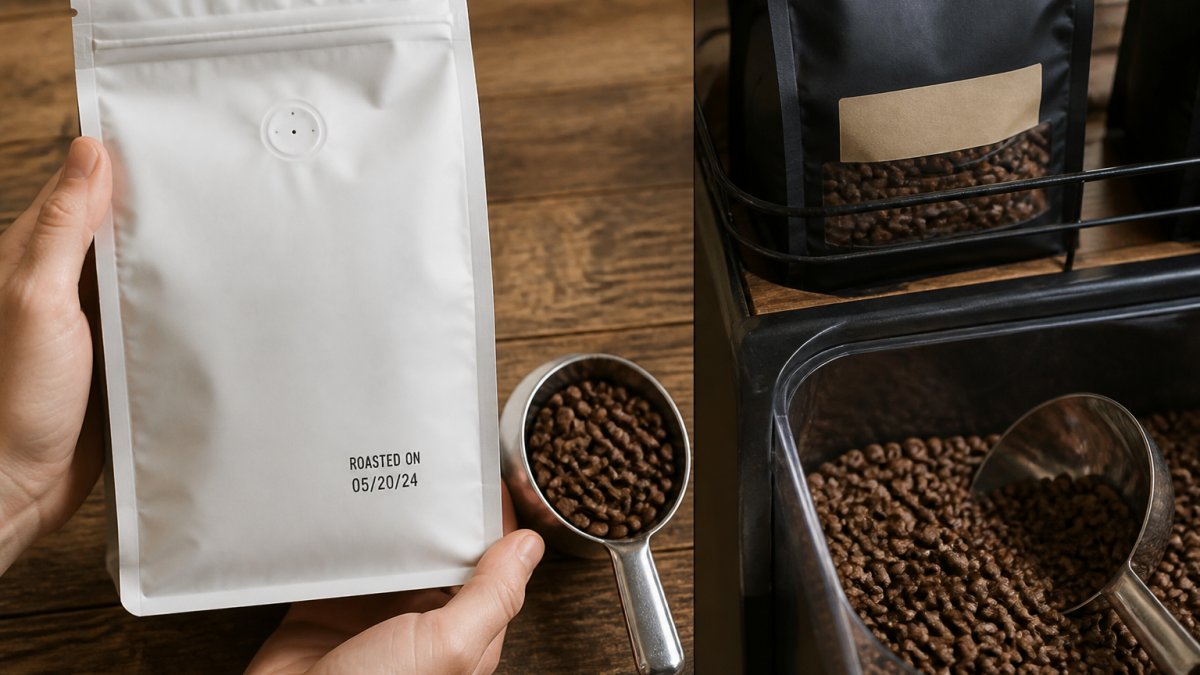
A common mistake is judging freshness by the "best by" date instead of the roast date. Best-by dates tell you when coffee is still safe, not when it peaked.
Cost Comparison: Coffee Subscription vs Grocery Store
A cost comparison of coffee subscription vs grocery store usually favors subscriptions once you account for the full picture, but only above a certain consumption level. Below that level, the store can be cheaper. The difference is the break-even point, and most articles never calculate it.
The break-even math
Start with your daily coffee volume. A standard 12-ounce mug uses about 15 to 20 grams of whole bean coffee, depending on strength and brew method. A 12-ounce bag holds about 340 grams.
Now compare the effective cost per gram, not the sticker price:
- Store-bought: A 12-ounce bag at a typical supermarket price often works out to a higher cost per gram than a bulk subscription, but the gap narrows if you buy store-brand or sale items. Add the cost of the trip, fuel, time, and impulse purchases, and the effective cost rises further.
- Subscription: A subscription's cost per gram drops as bag size increases. A 5-pound bulk order can cut the cost per gram substantially compared to a 12-ounce bag. The trade-off is that you must finish the coffee before it stales.
A simple rule: if you drink one cup per day, a 12-ounce bag lasts about three weeks. If you drink three cups per day, it lasts about one week.
A budget-conscious decision matrix
Use this matrix to match your weekly consumption to the likely cheaper option:
| Weekly coffee volume | Likely cheaper option | Why |
|---|---|---|
| 1-5 cups | Store-bought | You will not finish bulk bags before they stale; subscription shipping adds cost per cup |
| 6-10 cups | Either, depending on bag size | A 12-ounce subscription bag lasts 2-3 weeks; store sales can compete |
| 11-20 cups | Subscription | Bulk pricing and freshness reduce waste; cost per cup drops |
| 21+ cups | Subscription with bulk packs | Highest volume maximizes per-gram savings and delivery frequency |
This matrix assumes you drink coffee at home and do not waste much. If you throw out stale coffee, shift one row toward subscription. If you walk to the store and buy only what you need, shift one row toward store-bought.
The hidden costs of store-bought coffee
The hidden costs of store-bought coffee rarely show up on the price tag. They show up in the trip, the impulse buys, and the beans you throw out because they went flat before you finished the bag.
- Fuel and time for each store run
- Smaller bags that cost more per gram
- Beans that lose flavor before the bag is empty
What to check before you commit
Before choosing, calculate your own cost per cup: divide the bag price by the number of grams, then multiply by the grams you use per cup. Do that for both your store option and your subscription option.
Our 12 Pack Single Serve Coffee Capsules start at $22.99, and the 60 Pack comes in at $59.99. Buying in bulk lowers your cost per cup further, and each capsule is sealed with no oxygen inside so the coffee stays fresh.

Custom Grind Coffee Subscription Services: Matching Your Brewing Method
Custom grind coffee subscription services solve the problem store shelves create: one grind size that fits no one perfectly. Grind size controls how fast water moves through the coffee, so a grind built for a drip machine will over-extract in a French press and under-extract in an espresso basket.
We offer whole bean or a custom grind matched to your brewing method, from pour-over to espresso to cold brew. That matters if you have specific preferences and want consistency bag after bag.
| Brewing Method | Grind Size | Why It Matters |
|---|---|---|
| French press | Coarse | Prevents sediment and bitterness |
| Drip machine | Medium | Balances extraction time and flow |
| Pour-over | Medium-fine | Controls contact time for clarity |
| Espresso | Fine | Builds pressure for a proper shot |
| Cold brew | Coarse | Avoids harsh, over-extracted flavor |
Convenience and Delivery Frequency: Managing Your Supply
Delivery frequency is the control that makes or breaks a subscription. Set it too fast and bags pile up; set it too slow and you run out mid-week.
Track how many grams you use per day for one week. Multiply that by seven, then divide by the bag size you are considering.
If you travel, work remotely, or brew less in some months, look for a service that lets you pause or skip deliveries.
12 Pack Single Serve Coffee Capsules →
Environmental Impact: Carbon Footprint and Packaging Waste
The environmental impact of a coffee subscription versus store-bought coffee is not a simple win for either side. It depends on three variables most comparison articles ignore: the emissions of the last-mile delivery, the packaging format, and how much coffee you actually consume before it stales.
Carbon footprint: last-mile delivery vs. bulk grocery freight
A coffee subscription typically ships direct from the roaster to your door. That removes the retail distribution leg, the truck from roaster to warehouse to store, but it adds a dedicated last-mile trip to your address.
The break-even point is roughly this: if your round trip to buy coffee is more than a few miles, the emissions of that solo car trip can exceed the emissions of a subscription delivery that is already coming to your neighborhood.
Packaging waste: capsules, boxes, and bubble wrap
Packaging is where subscriptions can lose the environmental argument. A store-bought bag is usually one item: a foil-lined bag with a tin tie. A subscription shipment often includes an outer box, a padded mailer or bubble wrap, a printed insert, and sometimes individual capsules or single-serve packets.
That said, the comparison is not fixed. Many roasters now use recyclable or compostable mailers, and some capsule systems offer a take-back program. The key is to check what your provider actually uses rather than assuming. Ask three questions before subscribing:
- Is the outer mailer curbside recyclable, compostable, or landfill-only?
- Are the capsules or bags recyclable in your local program, or do they need a special drop-off?
- Does the roaster offer a refill or take-back option that reduces packaging per serving?
How to recycle coffee capsules and bags in your area
The waste angle most articles miss: stale coffee is wasted carbon
Every bag of coffee that goes stale before you finish it represents wasted carbon, water, labor, and transport. A supermarket bag with no roast date may sit on your shelf for weeks after it has already sat in a warehouse.
Fresher coffee you actually finish has a lower real footprint than cheap coffee you toss. That is the strongest environmental argument for a subscription, and it has nothing to do with shipping distance. It is about consumption efficiency.
A practical way to decide
If you drive to the store specifically for coffee and throw out stale beans, a subscription with recyclable packaging is usually the lower-impact choice. If you walk to the store, buy only what you finish, and your roaster ships in compostable mailers, store-bought can be competitive. The worst option is a subscription you cannot keep up with, bags piling up, going stale, and getting tossed.
Making the Choice: A Decision Framework for Your Coffee Routine
Use this framework to decide quickly. It weighs the factors that matter most: how you brew, how much you drink, and how much you value freshness over immediate access.
- If you brew daily and care about flavor: choose a subscription with a roast date and custom grind.
- If you need coffee today: buy in store, then set up a subscription for the next cycle.
- If you drink one cup a day: a smaller, less frequent delivery keeps coffee fresh.
Our Best Sellers Sample Pack at $26.99 and the Single Origin Favorites Sample Pack at $26.99 both let you test roast levels and origins before you settle on a plan.

The real challenge is not choosing between a subscription and the store. It is finding a roaster that ships fresh, grinds to your method, and lets you adjust without friction.
Frequently Asked Questions
Is it worth getting a coffee subscription?
It depends on how much you value freshness and convenience. A coffee subscription delivers beans shortly after roasting, so you avoid the stale stock that sits on grocery shelves for months. If you drink coffee daily and care about flavor, the freshness alone often justifies the cost. Subscriptions also let you customize grind size for your brewing method, which store-bought bags rarely offer. The main trade-off is committing to a recurring delivery, so check the cancellation policy before signing up.
How does coffee subscription freshness compare to grocery store beans?
Subscription beans typically arrive within days of roasting, while grocery store bags may sit in warehouses and on shelves for weeks or months past their roast date. Oxygen exposure degrades aroma, acidity, and body over time. Tampa Bean Company seals its single serve capsules with no oxygen inside to keep coffee fresh, and whole bean orders ship soon after roasting. If you check the roast date on a store bag and see nothing recent, a subscription gives you a clearer freshness guarantee.
Does a coffee subscription save money compared to buying in-store?
Often, yes, especially if you currently buy daily cups from cafes. A $6 daily coffee habit adds up to roughly $180 per month. Tampa Bean Company's 60 Pack Single Serve Coffee Capsules cost $59.99, which works out to about $1 per capsule, far below cafe pricing. Even against supermarket beans, subscriptions can compete once you factor in gas, impulse purchases, and the cost of replacing stale coffee you end up tossing.
How do I choose between whole bean and custom grind subscriptions?
Pick whole bean if you own a burr grinder and brew within a week or two of opening the bag, since grinding fresh preserves the most flavor. Choose custom grind if you want convenience or do not own a grinder. Tampa Bean Company offers your choice of whole bean or custom grinds matched to your brewing method, whether that is pour-over, drip, espresso, or French press. Match the grind to your equipment, and store beans in an airtight container away from light and heat.
What are the main benefits of choosing a local roaster subscription?
Local and regional roasters like Tampa Bean Company roast in smaller batches, so beans reach you closer to their roast date than mass-market brands. You also get access to single-origin options with distinct tasting notes, such as the Peru Single Origin in the Best Sellers Sample Pack with its salted caramel and citrus profile. Smaller roasters often let you pause, skip, or cancel without penalty, and some support community causes, which matters if you want your coffee dollars to stay close to home.